


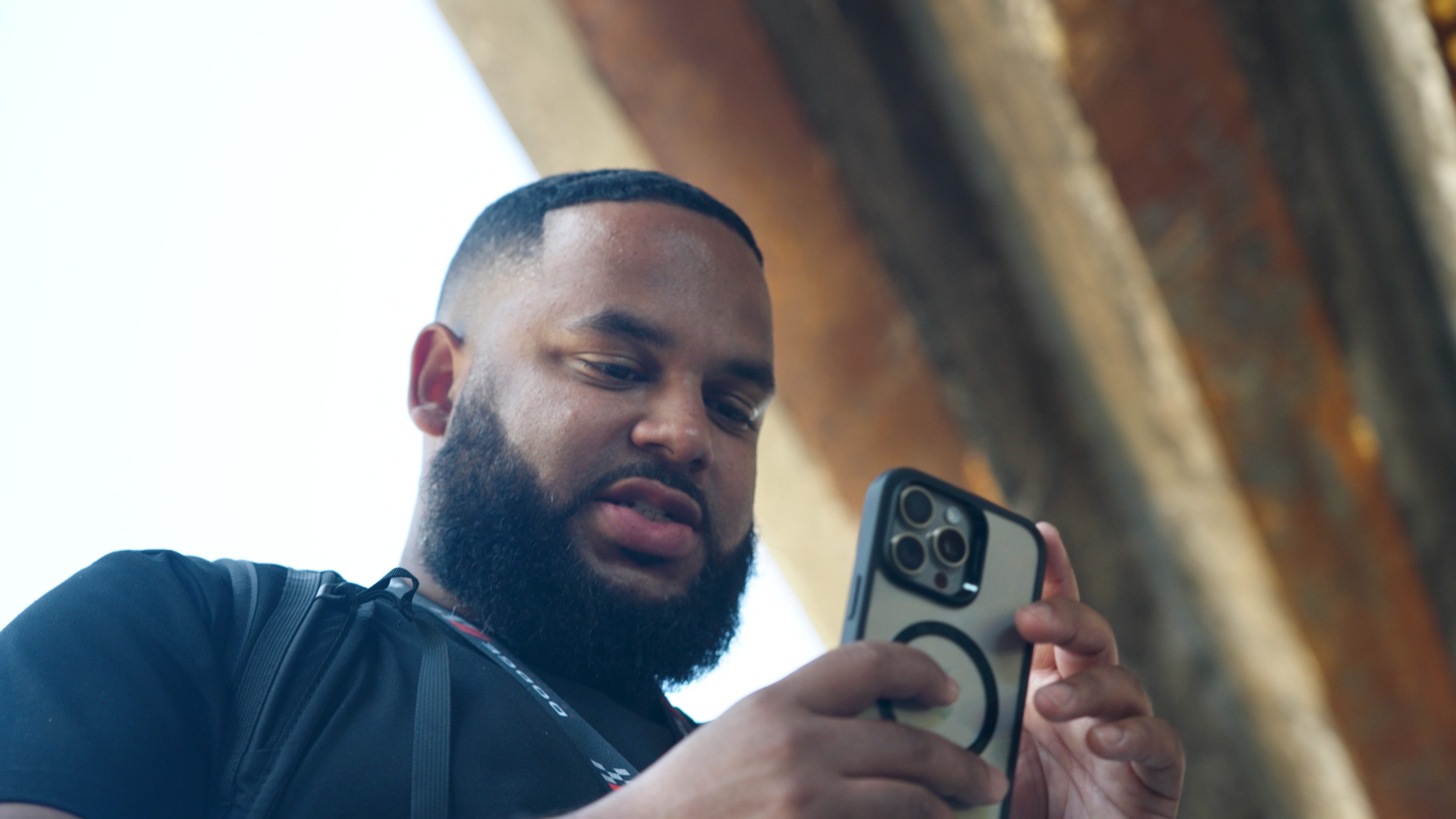


How influencers changed automotive marketing
What does it take to be an automotive influencer? We talked with some to find out.
- While some influencers maintain journalistic integrity, the lack of traditional media gatekeeping raises concerns about accuracy and accountability.
- The shift toward influencer marketing coincides with a decline in traditional newsroom employment and challenges in monetizing online news.
- The long-term effectiveness of influencer marketing for automotive sales remains uncertain, as it primarily focuses on brand awareness rather than direct sales.
On April 30, Maddison Lynn Collinge, a Detroit native living in Los Angeles, posted a lifestyle video on her Instagram account.
In the video, as the Doobie Brothers’ “Listen to the Music” plays in the background, a series of quick cuts show Collinge and a friend picking up drinks before heading to a store.
“Coffee & shopping in the desert,” reads the caption, followed by a cactus emoji. That is, until you expand it.
“Coffee & shopping in the desert (cactus emoji) in the @chevrolet Tahoe of course. Chevy brought us to the desert this weekend for Stagecoach and I couldn’t be more grateful,” the full caption read.
Collinge, who has over 550,000 TikTok followers and 27,000 on Instagram, is among a growing number of influencers and content creators working with brands like Chevrolet in order to gain access to product experiences and vehicles previously reserved for journalists, who would then write about them, while working at traditional media outlets.
Detroit automakers Ford Motor Co. and General Motors are among brands who have recalibrated their communications strategies in recent years to focus on influencers — whose short-form video content draws millions of views on social media sites — to get their product messages to more consumers.
The strategy commands a larger segment of automaker advertising budgets and communication strategies today — more than car buyers may realize. And no, not all influencers and content creators are working for free.
Automakers do not publicly disclose their marketing spend, so it is difficult to determine how much more they are allocating to digital sources. However, in 2024, creators topped the list for social media marketing budget priorities, as part of so-called influencer marketing, according to a Deloitte Digital analysis of hundreds of major companies, taking up 24% of the total yearly spend on average.
By the end of 2025, the Copenhagen, Denmark-based firm predicts that the amount spent globally on influencer marketing will reach $32.6 billion — roughly the same size of the global automotive advertising market.
At Ford, Karl Henkel, a former journalist, is responsible for transforming the automaker’s media site to fromtheroad.ford.com, which includes employee written blogs and freelance pieces. The site sidelined traditional news releases for more creator friendly content including more images and B-roll (supplemental video). Henkel said the shift is intended to capitalize on the influx of “enthusiasts, creators and internal and external influencers” posting about the company.
“Everything is so nuanced, and it always ties back to ‘Who are we trying to communicate with, and what are we trying to say?’ ” Henkel told the Free Press, part of the USA TODAY Network. Automaker communications “used to be 90% talking to journalists all the time. And then we started to add in influencers.”
Over at General Motors, Jessica Wang, senior content executive, oversees the Detroit automaker’s influencer programming. Most recently, Wang served as head of the editorial and creator hub at YouTube. Wang’s extensive experience at one of the largest and most influential social media platforms helps GM strategically reach audiences compared with traditional broadcast models of the past.
“GM has always worked with the main avenues (like radio, television, movies and newspapers) out there to tell our stories. Influencers and content creators, they’ve been around,” Wang said. “What we’ve been focusing on is how to add on to that, and shift some of our thinking toward ‘How do we keep up with how the creator economy is changing?’ ”
By creator economy, Wang is referring to a system that uses influencers like Collinge, whose social media followers are among consumers the company is trying to reach, to deliver marketing, rather than trying to reach them through journalists. Influencers film themselves interacting with products to share with their followers.
Vitally, it is called an “economy” because the influencers get paid, either directly from the social media platform, through sponsorships with individual companies, through free products or access to products or from advertising on their posts.
While Collinge is not paid directly by GM, the automaker provided the vehicle Collinge drives in her video to showcase how someone like Collinge could use a Chevy in her day-to-day life. Per her post, Chevrolet also picked up the tab for tickets to the country music festival Stagecoach.
The influx of influencer-made content might muddy the waters for prospective customers, experts said, when it’s not clear whether someone is delivering the news via an independent journalist or an advertisement, via an influencer.
“There’s no gatekeeping on social media. That’s the whole point,” said Josh Pasek, professor of Communication and Media and Political Science at the University of Michigan. “You no longer need a professional journalist class because anyone can publish.”
Viral influence
Most of the nearly 10,000 influencers who participate in Ford’s influencer marketing program, Friends of Ford, are gearheads, or people who are interested in cars and how they work — with some notable exceptions.
One creator recently invited on one Ford experience uses the handle “Grill Guy.” He’s a former teacher and varsity basketball coach in New Jersey who pivoted to social media content creation during COVID-19. He invited other creator friends to participate, with a combined reach of 4 million followers, according to Lauren Vrazilek, who manages the Friends of Ford program.
Friends of Ford falls under a similar bucket as journalists, where creators aren’t paid by the company and aren’t instructed on how their content should be presented, according to Vrazilek, who leads that program.
Grill Guy, whose real name is Kevin Spies, falls under that category. Though he did not accept money from Ford, Spies supports himself through sponsorship dollars from working with other brands. He started making videos of a talk-show-style grilling show in his backyard for a friend’s millennial parent website and quickly pivoted to comedy.
“Now I find myself at 37 finding people calling me an influencer … which is weird,” he told the Free Press. “And it is weird to see brands that I grew up loving — Ford being one of them — I’m now working with.”
Also a former special education teacher in Brooklyn, New York, Spies taught everything from history to biology, including a social-emotional learning course. When he plays golf on Thursday mornings, he said he finds himself having to explain what he does to make a living.
“I just say that I post low-brow comedic skits and — from a following that I’ve built from doing that — somehow brands have gotten in touch with me to promote their products,” he said. “Most of the people that are doing content creation full time, the biggest source of income is the brand partnerships.”
In-bound requests come from brands who reach influencers through their publicly accessible contact information, Spies said, and newcomers tend to say “yes” to almost any partnership that pays well.
Creators can make up to $5,000 on brand deals, though depending on their following, an influencer can take home salaries in the six figures.
The average annual influencer income in Detroit is $64,590, according to job search site ZipRecruiter. Nationally, the site reported recording annual income as high as $116,500 and as low as $35,000.
But the Wild West of paid content is still being tamed, and influencers new to the game have to negotiate terms more or less on their own.
“There’s no set prices for any of this. At first, when you’re working alone, your price is whatever the last brand paid you, really,” Spies said. “So if you can get a deal for a post for X amount of dollars, you don’t want to go back to doing it for less than that, because you’re taking a step back.”
Formal influencer programs
When virtual unknowns go viral, automotive companies try to get in on the action.
The cohort of influencers touting massive audiences on platforms such as TikTok, YouTube and Instagram may soon outstrip mainstream advertising opportunities like pop-up ads on articles or in social media feeds. Last year, influencer marketing on social media surpassed paid search (think Google ads) to become the world’s largest advertising channel, according to private media company Influencer Marketing Hub.
Brands are constantly searching for new ways to reach audiences and are more than willing to borrow the reach of those who have millions of followers on social media, said EJ Schultz, a reporter for Ad Age who has followed automotive marketing programs for decades.
“The word influencer is overused today. It’s hard to tell what it means anymore,” he said. “More importantly and recently, the use of micro-influencers — folks that may not be broadly famous but have expertise and knowledge in niche areas with followers that put a lot of trust in them — has taken off with automakers.”
Much like other major brands that have waded into the content creation space, Ford maintains several influencer programs. In addition to the creators in the Friends of Ford program, the automaker has Ford Influencers, who are employees with large social media followings and external influencers known as Ford Ambassadors who produce paid-for sponsored content.
Friends of Ford gain access to brand updates, exclusive content and some even attend exclusive events, including vehicle launches, off-roading drives, reveals, and track days, Vrazilek said.
“We’ve got to reach people where they are, and where they receive their information,” she said, adding that if companies only focus on speaking to traditional media outlets, “you’re not doing it right.”
When it comes to the flow of cash from companies to private citizens, the influencers aren’t to blame, Pasek, of U-M, said. But it does get confusing. Without the same training or standards for fact-checking as journalists, influencers aren’t able to provide assurances for their viewers to know they can trust what they are seeing.
“They’re not at fault here. We’re operating in a nether media space between an environment with clear rules and an environment without rules. The one without happened to suck all the money out of the one with clear rules,” Pasek said. “It was a nice coincidence that in the past, the demand for journalism was well covered by advertising. Unfortunately, that is no longer the case.”
Former journalists go solo for money
Not all social media stars entered the space without training or experience in old-school media production. Texan Alanis King, a video presenter and car reviewer, editor-at-large at the Motorsport Network, is extremely selective about the companies from which she accepts money.
“I really try to stay grounded and focus on my original journalism training, but I understand I’m no longer a traditional journalist,” King said. “I’m not making a salary anymore; I am making my own money with all these deals here and there.”
Previously, King worked as a writer and editor at automotive industry blog site Jalopnik and at Business Insider, as well as a content creator at Cars & Bids. Her YouTube channel grew to 35,000 viewers after just one year.
Other former journalists, like New Yorker Ariel Viera, have no automotive writing background. He garnered 1.8 million followers across TikTok, Facebook, Instagram and YouTube for his architecture and history videos. He previously worked at Gawker and Vox.
“The fatal flaw with traditional media is that they didn’t have good personalities. It wasn’t quite authentic,” he said. “I quit because it focused on doom and gloom, and I knew there was no space for me in traditional media.”
Viera said he considers himself an entertainer, first and foremost, and provides enough educational material to help his views further any research he uncovers. His channel served the ideal audience for the PBS series “Great Migrations: A People on the Move,” which Ford invited him to Detroit to promote in January.
Viera said companies now come to him for partnerships, which allows him to be more selective and discerning than a content creating newcomer. Typically, Friends of Ford are not paid, though Viera said he negotiated a stipend, some of which covered his lodging and travel expenses.
“I’m bombarded quite a lot. Usually, I choose partnerships if I admire something about the company or organization, or I’m curious to learn more,” he said. “In the context of Ford, I admired that they were such an innovative company, and the fact that they preserved the train station.”
More trust in individuals than institutions
Consumers reported following an average of seven brands on social media compared with 13 creators and influencers, according to the 2025 State of Social Media report published in May that surveyed 1,000 people in the United States active on one of the major social media platforms that had made a purchase online in the past 30 days. Those responses were fielded April 10-19 of this year.
And among those respondents, 83% said they considered the influencers or creators they follow on social media as trusted sources of information.
“In a world where there’s an increasing level of mistrust in content we engage with online, what you’re going to hear a lot in dialogue around the creator economy is that they are these trusted sources,” Kenny Gold, managing director and head of social, content and influencer at Deloitte Digital, told the Free Press. “This is a massive shift in marketing strategy and philosophy.”
Deloitte surveyed 390 high-level employees April 1-11 this year at companies across various industries with 500 or more employees and $500 million or more in annual revenue.
On average, those companies surveyed reported raising spending on influencer and creator marketing 9% in 2024.
In a separate study, Deloitte learned that Generation Z — widely considered those born from 1997 to 2012 — spends 50 minutes more per day than the average consumer on social platforms, watching user-generated content.
Yet another study, the Digital Media Trends study, found the average member of Gen Z is watching an average of 6.5 hours of video per day on their cell phones. That same study found 56% of Gen Zs and 43% of millennials surveyed reported that social media content is more relevant to them than traditional content like TV shows and movies.
“We’re dealing with a consumer that goes straight to the sources they trust versus the sources maybe their parents or grandparents trusted,” Gold said. “As the creator economy continues to evolve, the checks and balances that will be created by governments, markets and systems will govern the way it goes out in the world.”
As the class of professional influencers rise, professional journalism shrinks.
A June Reuters report found that 72% of people in the U.S. consume news video weekly, up from 55% in 2021. Of that, 61% of those videos are viewed on Facebook, Instagram, TikTok and YouTube.
Many of these videos are not created by trained journalists, but rather “news influencers” — 77% of whom have no news background.
Newsroom employment in the United States dropped by 26% from 2008 to 2021, a loss of roughly 30,000 jobs across newspapers, radio, broadcast television, cable and “other information services,” according to an analysis of U.S. labor statistics conducted by the Pew Research Center.
The vast majority of respondents to a Pew Research Center survey conducted this March said they have not paid for news in the past year. The remaining 17% responded that they have directly paid or given money to a news source by subscribing, donating or becoming a member during that time.
The most common reason cited? They can find plenty of other news articles for free.
“The thing I tell people who don’t know much about our industry — you used to be able to read a lot of good stuff,” King said. “A lot of those websites are gone now, and a lot of those writers have taken jobs doing something else.”
‘Like a gold rush’
Roman Mica, a former broadcast reporter, shot his first car video on his son’s flip phone in 2009 and posted it to the emerging YouTube. For the next two years, he said he posted a car video every single day, including holidays. “It was like a gold rush,” he said, about the ability to produce widely viewed videos and make advertising revenue from the social media.
Though he graduated with a broadcast journalism degree from Northwestern University in 1987, Mica said he’s considered a social media star more so than an objective news source.
“Authenticity is the currency of any social media. You’re almost better off being a novice than an expert on something,” he said. “The key was you had to have editorial independence. Stories shouldn’t be bought and paid for. That’s what influencers are now. They’re advertising but not calling themselves advertising.”
That isn’t to say there aren’t any guardrails for influencers. Mica’s YouTube channel, The Fast Lane Car and Truck, has over 1.5 million subscribers across its different streams who find ways to keep him and his other auto reviewers honest. The company also has 1.3 million TikTok followers.
“When I was a TV reporter, it was very much a one-way conversation. With a YouTube channel or any social media, it’s always a two-way conversation,” he said. “Your followers and fans, in effect, hold you in check.”
Dodge superfan Tim Dalton would agree. The Wayne, Michigan, resident said some viewers who are drawn to creators are drawn far more for their personality than the information provided in their content.
“You clearly enjoy how they presented the creative side, their personality,” Dalton said. “They’re funny. You like watching those just like watching the show.”
Dalton is among the growing number of metro Detroit automotive influencers. Since 2022, Dalton’s Hellcat Durango fan page on Instagram has garnered nearly half a million followers. Even though he is not paid by the automaker to express positive views on social media, he said he has struggled with some pushback from commenters who cast doubt on his opinions.
“A couple of the comments were like, ‘Oh, he’s getting paid to say that.’ But I’m like, ‘I truly enjoyed the car,’ ” he said. “I truly liked it.”
It’s one of the flaws in creating content on your own rather than working for a company. An institutional name can not only add legitimacy to a journalist, it can also protect them. Viera said that if a content creator accepts money from a company, it usually includes stipulations against defaming the brand, organization or institution.
Therefore, he added: “The thing with content creators is, you can’t be too much of a critic because you won’t be invited to things.”
Mica’s YouTube channel has internal policies that maintain objectivity, Mica said, and, like King, it has a rule about not taking any sponsorship dollars from any of the car manufacturers. Still, he said he is aware of the corrupting influence money can have on those without the same training or feelings of responsibility to uphold the truth.
“For my generation, that was considered selling out. But with the younger generation, especially those that strive to be influencers, that’s a sign of success. Getting the big brand means you made it,” Mica said. “If we were to advertise something, let’s call it problematic, what would happen is our community would get up in arms and we would lose that community very quickly.”
Automakers tell their own stories now
General Motors has joined Ford in completely revamping its forward-facing media sites in the past year to more closely resemble a news outlet than simply a place to find news releases and images.
The goal? Offering more video, photos and articles sourced from outsiders and company employees alike to reach the widest cross section of the internet as possible.
Ford was among the first to try to leverage early influencers. In 2009, the automaker’s marketing team launched a social media strategy aimed at attracting young buyers to the 2010 Ford Fiesta. The six-month initiative, called “The Fiesta Movement,” was the legacy automaker’s first major venture into the influencer landscape. The success of that program, which featured 100 influencers, paved the way for today’s strategy of working closer with nonemployees according to Henkel.
“Every company thinks that their headquarters is the center of the universe,” Henkel said. “But the beauty of being able to take those stories of people who are still in our circle — we let the story breathe and let them use their own words. If we try to fit everything in a box, we end up like every other corporation.”
What are the rules?
Ford’s crosstown rival launched its own human-interest channel “GM News” last year, helmed by longtime Barron’s reporter Eric Savitz. In between his tenure covering technology and investing, Savitz spent six years in corporate communications. In a blog post announcing his role and the new platform, Savitz emphasized two key characteristics of the site: less jargon and more voice.
Savitz said that the site is not meant to replace journalism. Some of what it publishes mirrors newsy or magazine-style pieces, often written by communications experts or former journalists. GM News recently launched two series about its own employees, “On the Job” and “Off the Clock,” highlighting interesting facts and information about their roles at GM or insights into their personal lives.
Occasionally, GM News holds back on stories it believes it can pitch to traditional media sites for a chance at a broader readership, Savitz said.
“I don’t think we’re in most people’s daily news diet,” Savitz said, but he noted that the company still took great care in how it named the revitalized platform. Calling it GM News, he said, is meant to showcase the platform as a source of reliable information for anyone to use, not just traditional media.
“Look at some of the traffic numbers. There are people on YouTube getting tens of millions of views,” he said. “You can’t really ignore them and they like to drive our cars. But the rules are different.”
Those rules, as most in the game are aware, include a set of traditional values handed down from editorial educators and enforced across various media institutions, Pasek said.
“You screw up as an influencer, you either do a rebrand or go down. The framework of accountability does not require the same standard of evidence, of fact-checking, or accuracy because you don’t have an institution that is also on the line for the mistake,” Pasek said. “The only person that gets hit by the mistake is the individual and they can just go somewhere else. A media company can’t do that.”
Does influencer marketing work?
Because people don’t buy cars every day — in fact, the average age of a vehicle on U.S. roads climbed to 12.8 years in 2025, according to an analysis released in May from S&P Global Mobility — influencer-made content is harder for automakers to measure than mainstream advertising content, Schultz said.
“With automotive, influencers are still being used as an upper funnel sort of tool where it’s more about brand awareness,” Schultz said. “It would be rare cases where an influencer post is directly leading to a sale.”
One of GM’s goals is to move from one-off interactions with creators, such as partnering on a specific product launch, and developing long-term relationships similar to how the company operated with traditional media in the past, Wang said.
Launching GM News was a way to “delve into rich stories” and history across the company is “one lever we’ve really invested in,” she said. “Another is ‘How do we really be native to the way people are telling stories on these different platforms?’ ”
GM begins examining a creator’s content and audience and whether it seems like a good fit, whether the creator has a reputation for explaining complex topics such as preparing vehicles for consumers or how an electric vehicle battery is constructed.
The industry, in Wang’s estimation, has moved beyond chasing big names with impressive subscriber figures in favor of niche creators who command a more concentrated influence.
“Have they built a strong community over time? Did they do that through being very consistent, very transparent?” she said. “That relationship with an audience is something that we really value and look at very closely.”
One recent recruit to the team was Grace Kerber, a 24-year-old former employee of Mohawk Chevrolet in upstate New York and one of the masterminds behind the viral marketing series for the store modeled in the mockumentary style of shows like “The Office,” dubbed “The Dealership.”
Kerber now works as a content creator for GM.
This strategy mirrors what Deloitte has seen across the industry. Savvy companies can find ways to spend less while targeting viewers that are more inclined to listen to the creator they follow, Gold, of Deloitte, said.
“Old-school media strategy would tell you, the more people you reach, the higher chance you have of driving the growth you’re looking for,” Gold said. “But since creators with smaller communities tend to have higher engagement rates with their audiences, a higher level of trust, they tend to generate better returns.”
Doing what works
To their credit, most influencers who gain popularity lean on their own moral compass to maintain authenticity, which, in turn, helps keep their content as honest as possible. For Spies, he said he wouldn’t have agreed to work with Ford if he didn’t consider himself a Ford customer first.
“Indirectly, it makes you more valuable to other brands,” Spies said of agreeing to work with Ford. “The reputation, name and size of Ford — as a creator, you want to be tied to that.”
Even so, people don’t come to Spies for information, he said. They come for a giggle.
“People look at me and say, ‘you’re an influencer,’ and there’s a weird connotation to that,” he said. “But on the same token, I can post whatever I want, whenever I want. I can say whatever I want. But I rarely try to give information, especially on things I’m not informed about.”
Impartiality is crucial to informing the public, former journalist and now influencer Viera said, which is why he’s a particularly strong advocate of investigative journalism. If he doesn’t feel that he’s serving his audience, he works to make sure they find the resources to address more complicated topics.
“The rules of media, in a way, have to adapt and they haven’t quite yet,” Viera said. “There’s a confusion, I think, in why who covers what.”
Still, influencers aren’t to blame for their success, nor for the shifting media landscape, Pasek, of U-M, said. They’re simply doing what works.
“There is a level of credibility that these folks are not able to achieve,” Pasek said. “But they’re not really incentivized to assess what makes them different from journalists.”
But society needs to figure out a solution to this new media world where there are considerable concerns around credibility.
Until then, traditional journalists who play by the old rules, and are not paid, still serve a purpose, Pasek said: “I don’t think we’re in a state where a trusted authority is not needed anymore.”
Jackie Charniga covers General Motors for the Detroit Free Press. Reach her at jcharniga@freepress.com.
link